
Ring identifier: what is this ring?
Upload a photo of your ring. The report names the ring type and setting, reads the stamp inside the band, describes the stones and metal, places it in an era and gives a value range.
Free preview on every photoYour photo is read once in memory and never stored. Only the written report is kept, and only when you unlock it.

Found a ring in a drawer, inherited one, or bought one secondhand? Identify it from a picture before you sell it, insure it or pay for an appraisal.
What the ring identifier reads from a photo
- Ring type and setting: solitaire, halo, eternity, signet, cluster or band, and how the stones are held (prongs, bezel, channel, flush).
- Stones: shape, cut, colour and how they sit. Old cuts such as rose and old mine cuts are a dating clue on their own.
- Metal: colour, tone and wear. Plating that has worn through at the edges shows a different metal underneath.
- Stamps inside the band: karat or fineness marks (14K, 585, 750, 925, PT950), maker marks and hallmarks, transcribed only as far as they are legible.
- Age and origin: a likely date range and the features for and against it.
- Value: a resale range, with the evidence it rests on and what would move it.
What type of ring is this? The common types and how to tell them apart
Most rings fall into one of these types. The report names the type and the features it read it from, so you can check them yourself.
| Ring type | How to recognise it | When it was made |
|---|---|---|
| Solitaire | One centre stone, usually on four or six prongs, plain band | Engagement rings from the late 19th century on |
| Halo | Centre stone surrounded by a ring of small stones | Popular in the 1920s and again from the 2000s |
| Three-stone (trilogy) | Three stones in a row, the centre one often larger | Common in every period since the Victorian era |
| Eternity band | Stones set in a continuous line, half or all the way round | Mostly mid-20th century to today |
| Cluster | Several stones grouped into one head, often a flower shape | Strong in Georgian, Victorian and 1950s–70s work |
| Signet | Flat or oval top, plain, engraved with initials or a crest | Every period; heavy hand-engraved crests point older |
| Claddagh | Two hands holding a crowned heart | Irish tradition, made continuously since the 18th century |
| Gypsy (flush set) | Stones sunk level into a heavy domed band | Late Victorian and Edwardian men's rings, revived since |
| Cocktail | Large statement stone or cluster, tall head | 1940s–60s, often with synthetic or paste stones |
| Wedding band | Plain band: D-section, court (comfort fit) or flat profile | Every period; the inside profile and stamps narrow it down |
How to photograph a ring for identification
- Top view, in daylight. Ring flat on a plain white or grey surface, phone directly above, no flash. This shows the type, the stones and the metal colour.
- Side view of the head. The profile shows how the stone is set and whether the gallery under it is open or closed, which separates modern from older work.
- The stamp inside the band. Tilt the ring so light rakes across the inside of the shank and fill the frame with the mark. If the ring has a readable stamp, this close-up is usually the most informative single photo.
Each analysis reads one photo. Start with the photo that shows the most; run a second one for the stamp if the first report says the mark was not legible.
A sample ring report
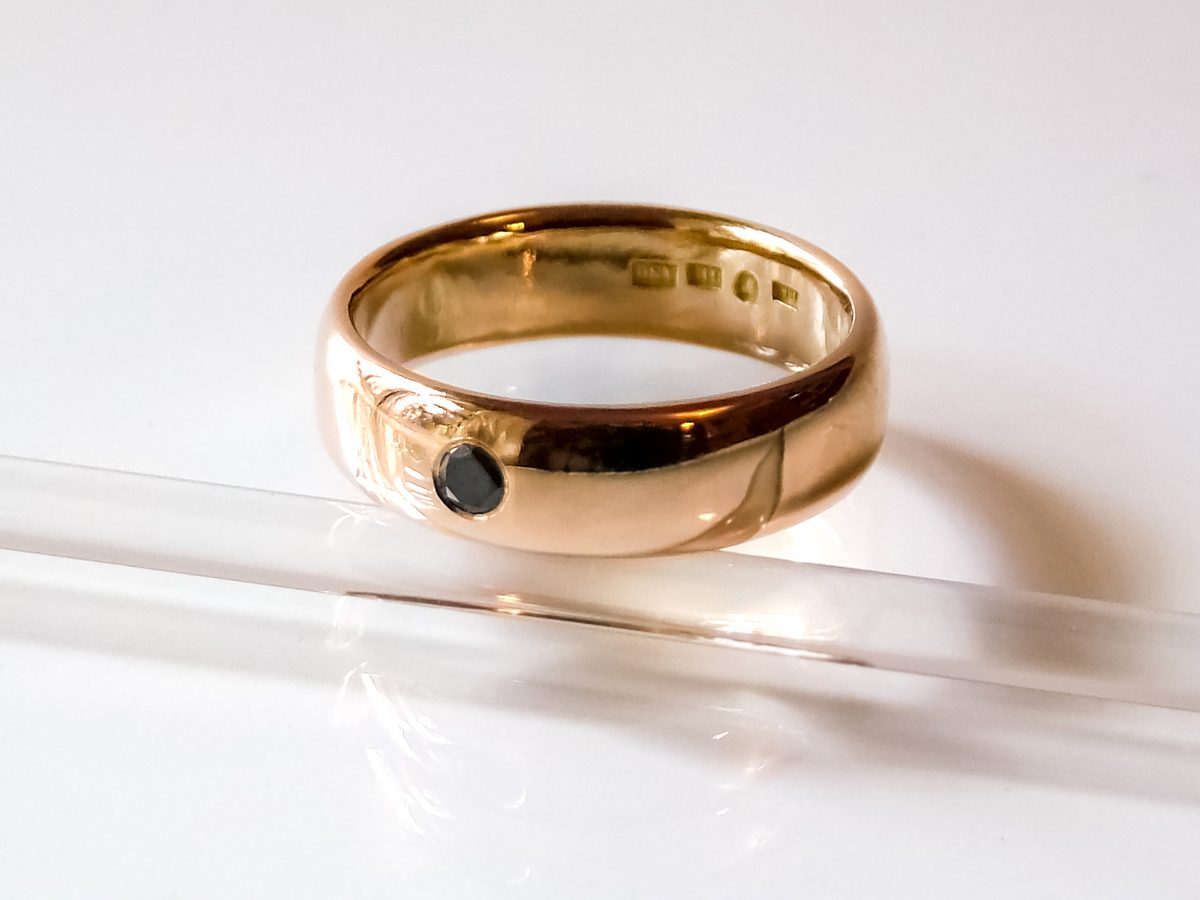
This is from the sample reports on our home page: a wide domed band in warm yellow metal with one small dark stone set flush into the outer face.
| Ring type | Wide D-section band with one flush-set accent stone |
| Setting | Rubover collet, stone level with the surface, off-centre toward one shoulder |
| Stamp | A row of five punches inside the band; no character legible at this angle |
| Age | Mid-20th century to the present; the five-punch layout keeps a British origin possible |
| Value range | $80–$400, wide because the mark is unread and the stone unconfirmed |
| Next step | Photograph the punch row close up under raking light; a legible fineness mark narrows the range |
The report says what it could not read rather than guessing it. A wide value range means the evidence in the photo is thin, and the next steps tell you which photo or check would narrow it.
Reading the stamp inside your ring
The stamp is the strongest single clue to what a ring is made of. 14K or 585 claims 58.5% gold, 18K or 750 claims 75%, 925 claims sterling silver, PT950 claims platinum. Letters after a karat mark change the meaning: 14K GF is gold-filled and 18K GP or HGE is plated, not solid gold. Look up any mark in our jewelry stamps table, and for British and European assay marks see how to read jewelry hallmarks.
Is my ring real?
A stamp is a claim, not proof, so the report also looks for what contradicts it: plating worn through at the edges, a base-metal colour at high points, a stamp that does not match the style. For the at-home tests and which ones actually work, read how to tell if jewelry is real. To put a number on a gold band, the jewelry value estimator works out melt value from the stamp and weight.
What a photo cannot tell you
A picture cannot weigh a ring, test the metal or grade a diamond. Lab-grown and natural diamonds look the same in any photo, and so do a well-made plated band and a solid one with no stamp. The report keeps these as estimates with a confidence, and when the ring could be worth an appraisal it says so. See our jewelry appraisal guide for what an appraisal costs.
Frequently asked questions
Can I identify a ring from a picture?
Yes, for most of what matters. A clear photo shows the ring type, the setting, the stone shape and cut, the metal colour and wear, and any stamp inside the band. The ring identifier reads those and says what the ring most likely is, with a confidence for each point. What a photo cannot do is weigh the ring or test the metal, so those stay estimates until checked in hand.
What type of ring is this?
Ring types are told apart by the head and the band: one centre stone on prongs is a solitaire, a centre stone ringed by small stones is a halo, a band set with stones all the way round is an eternity ring, a flat engraved top is a signet. Upload a photo and the report names the type, the setting style and the features it based that on.
Will the ring identifier tell me where to buy the same ring?
No. It identifies what your ring is: type, materials, marks, likely age and a value range. Finding a shop that sells the same model is a reverse image search job; Google Lens is the tool for that.
How much is my ring worth?
The report gives a resale value range with the evidence it rests on. For a plain gold band the floor is the melt value of the gold, which you can work out from the stamp and the weight on our jewelry value estimator page. Stones, a maker signature or an antique setting push the value above melt.
Is the ring identifier free?
Every photo gets a free preview with the identification headline. The full report, with every section, the value range and the next checks, is a one-time unlock. There is no subscription.